Suggested Praise Songs:
- Before the Throne of God Above
- Draw Me Close | feat. Michael Bethany | Gateway Worship
- Way Maker (Lyric Video) – Leeland
Resources for Family Worship (with Children):
- The construction of the tabernacle | Animated Bible Stories | My First Bible | 26 – Lesson for Kids
- I Am a C-H-R-I-S-T-I-A-N Song Lyrics – Song for Kids
- My God Is So Big (introducing Grayson the Elephant) – Song for Kids
- Doxology | Cross Culture Thailand VBS | Outback Rock VBS | Group Publishing – Song for Kids
- Discussion Questions for Children & Youth arelocated in the section after Explanation, Meditation, and Prayer (at the end of this email/blog).
Explanation:
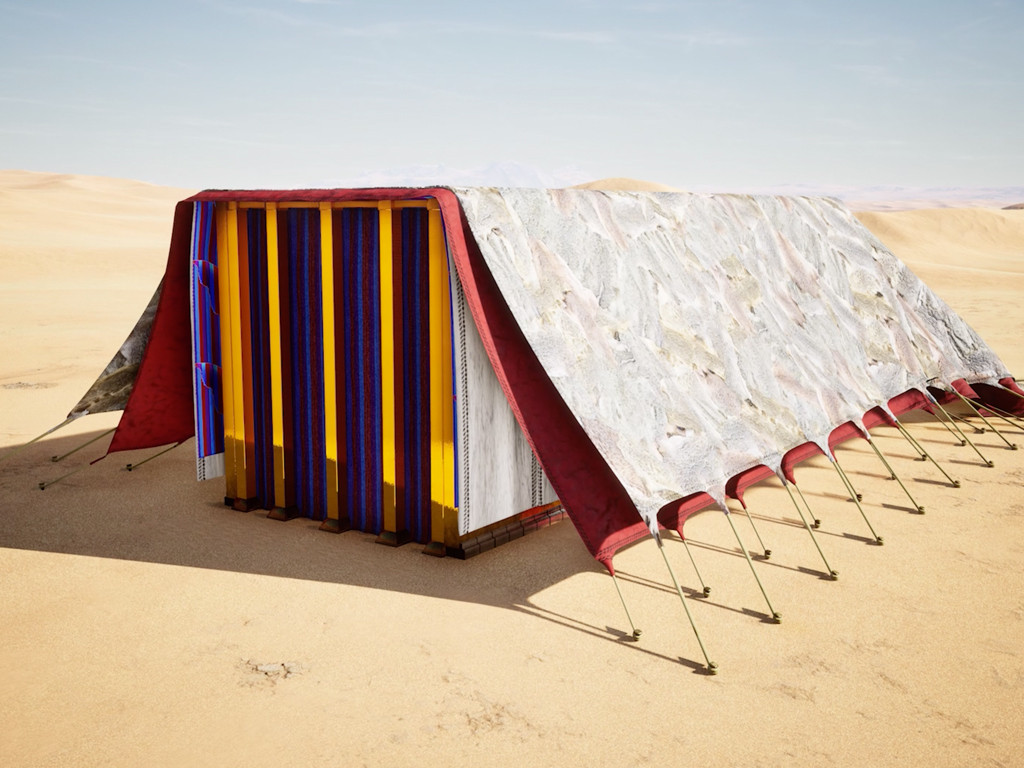
Following the instructions concerning the Ark of the Covenant, the table, and the lampstand, God gives directions about the tabernacle. It is helpful first to read the instructions for the tabernacle’s framework (verses 15–30) to understand the overall structure. The framework is made by joining boards of acacia wood (also known as shittim wood), each measuring ten cubits long and one and a half cubits wide. On the south and north sides, twenty boards are joined together, and on the west and east sides, six boards are joined. This forms a rectangular prism-shaped space made up of twenty-six boards.
Once the rectangular frame is constructed, it must be covered with a tent made of ten curtains. Each curtain is to be finely twisted with various threads, and images of cherubim (mythical creatures symbolizing heavenly beings) are to be embroidered on them (verses 1–6). Over this, eleven curtains made of goat hair are to be laid (verses 7–13), and over that, a double covering made from ram skins dyed red and hides of sea cows is to be placed (verse 14).
The interior of the tabernacle is divided into two parts, separated by a curtain (veil). The space on the west side is the Most Holy Place (also known as the Holy of Holies), and the space on the east side is the Holy Place. The curtain must be woven with various threads and embroidered with cherubim (verse 31). The curtain should be supported by pillars of acacia wood overlaid with gold (verse 32). In the Most Holy Place, the Ark of the Covenant (also called the Ark of the Testimony) is to be placed, and in the Holy Place, the table for the bread and the lampstand are to be placed (verses 33–37).
Meditation:
The tabernacle, a mobile sanctuary, was later transformed into a permanent temple by Solomon. The reason for the tabernacle’s existence is expressed in the words, “so that I may dwell among them” (Exodus 25:8). The tabernacle was the evidence that God dwelt among the people of Israel. For this reason, during their wilderness journey, the Israelites always arranged their camp with the tabernacle at the center. After the temple was built, it was believed that wherever and whenever one prayed facing the temple, God would hear.
The “eye” of the tabernacle was the Ark of the Covenant. Even within the tabernacle, the Ark was kept separately in the Most Holy Place, which was veiled by a curtain. Only the high priest could enter the Most Holy Place. Not only were the general people not allowed to enter, but even the priests were not allowed to enter. The veil that separated the Most Holy Place from the Holy Place symbolized the unbridgeable distance between God and humanity. Just as there was a boundary at the foot of Mount Sinai that the common people could not cross, the tabernacle also had a boundary that humans were not to go beyond.
Humans, because of sin, can never recklessly approach the holy God. That boundary can only be crossed by God Himself. And only when God permits it, may a human cross that line. That privilege was granted to only one person—the high priest. God spoke to the people through the mediation of the high priest, and the people could come before God only through that mediator.
When Jesus died on the cross, the curtain of the temple in Jerusalem was torn in two from top to bottom (Matthew 27:51). This signifies that by bearing all the sins of humanity and dying, Jesus destroyed the wall between God and humanity. The author of Hebrews states that Jesus, as the eternal High Priest, offered an eternal sacrifice with His own life, thereby removing the barrier that stood between God and humanity.
The wall of sin that had blocked the way between God and people has been torn down. Now, anyone may come before God through the grace of the blood of Jesus Christ. There is no longer any need for a human mediator. In Jesus Christ, the eternal Mediator, we can approach the throne of God’s grace with boldness (Hebrews 4:16).
Prayer:
Lord, who became the true Temple, we thank You for the grace that allows us to come before the throne of the holy God’s grace and call You “Abba” in Christ. We thank You for allowing us to dwell in the Most Holy Place and walk with You. Help us always to remember how You have transformed our very being. Amen.
Discussion Questions for Children & Youth:
Key Point: Because of Jesus, we no longer need a special curtain or a priest to meet God. Jesus opened the way for all people—children and adults—to come close to God at any time. Now, God lives not just in a building, but in our hearts.
- For Preschool-Elementary
- What do you think the big curtain (the veil) in the temple was for?
- How do you feel knowing that Jesus made it possible for you to be close to God?
- Where do you feel God is with you during your day—at home, at school, or somewhere else?
- For Youth
- Why do you think God once kept people separated from the Most Holy Place?
- What does it mean to you that Jesus tore down the barrier between us and God?
- How does knowing you can personally approach God—without needing a human mediator—change the way you pray or think about worship?
 사귐의 소리 2025
Leave a comment